

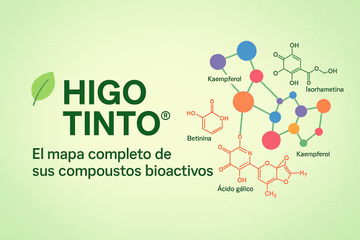
What does the FIGO TINTO® actually contain? What active compounds make it such a functional plant?
A study published in India has conducted a comprehensive analysis of the chemical profile of Opuntia dillenii , confirming that both its fruit and its pads are loaded with secondary metabolites with antioxidant, anti-inflammatory, antimicrobial and cell-protective activities.
What was studied?
Pads (cladodes) and fruits were collected, dehydrated, pulverized, and subjected to successive extractions with solvents such as:
-
Petroleum ether
-
Chloroform
-
Ethyl acetate
-
Methanol
-
Distilled water
Subsequently, classical phytochemical tests and spectrophotometry were applied to estimate the concentration of metabolites such as phenols, alkaloids, flavonoids, terpenoids, saponins, and steroids .
Main phytochemical results
| Compound | Cladode (mg/100g) |
Fruit (mg/100g) |
|---|---|---|
| Phenols | 6.8% | 5.2% |
| Alkaloids | 5.4% | 4.3% |
| Flavonoids | 3.2% | 1.8% |
| Saponins | 0.8% | 0.9% |
| Terpenoids | 0% | 0.6% |
| Steroids | Detected | Detected |
| Tannins | Missing | Present |
The highest content was of phenols , powerful antioxidants, followed by alkaloids and flavonoids , with strong antimicrobial, anti-inflammatory and DNA-protective activity.
Interpretation of the compounds
-
Phenols : neutralize free radicals and slow down cellular aging.
-
Flavonoids : stabilize blood vessels, improve circulation and modulate the immune response.
-
Alkaloids : some have an effect on blood pressure, the nervous system, or antibacterial properties.
-
Saponins : act as natural emulsifiers, beneficial for cholesterol and immune defense.
-
Plant steroids : such as β-sitosterol, modulators of lipid metabolism and anti-inflammatories.
Which part is more powerful?
-
The cladode contains more phenols, flavonoids, and alkaloids than the fruit, suggesting that its consumption could offer more functional benefits in terms of antioxidants and cell protection.
-
The fruit , on the other hand, has terpenoids and tannins , absent in the stalks, which reinforces its profile as a coloring, preservative and mild antimicrobial ingredient.
Practical application and relevance
This type of analysis supports the development of functional products like those currently produced at Tuno Canarias, where every part of the FIGO TINTO® is used to add value:
-
Digestive Creamer – FIGO TINTO® + prebiotic fiber for digestion and antioxidant protection
( https://tunocanarias.com/products/higo-tinto-digestive ) -
BOOST with RED FIG® – active antioxidant formula with ginger, turmeric and RED FIG extract®
( https://tunocanarias.com/products/higo-tinto-boost ) -
HIGO TINTO® Family Max – a functional, sugar-free powder mix, ideal for the whole family
( https://tunocanarias.com/products/higo-tinto-family-max ) -
100% RED FIG® organic powder – complete extract for capsules, smoothies or custom formulas
( https://tunocanarias.com/products/higo-tinto-eco )
Conclusion
This study confirms that the TINTO FIG® is a versatile and potent source of secondary metabolites , both in its fruit and its leaves. Its richness in phenols, flavonoids, alkaloids, and steroids positions it as an ideal plant-based ingredient to support cellular, immune, and metabolic health in natural formulations.
Knowing what a plant contains is key to understanding why it works. The TINTO FIG® has it all, and in good proportion.
Reference
Suryawanshi P., Vidyasagar G. M. (2016)
Phytochemical screening for secondary metabolites of Opuntia dillenii Haw
Journal of Medicinal Plants Studies, Vol. 4(5): 39–43