

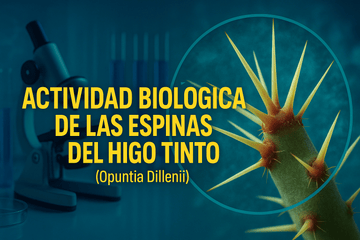
What if I told you that the thorns of the TINTO® FIG are not only not a waste product... but one of its most potent treasures?
While many focus on the pulp or skin of Opuntia dillenii (TINTO FIG®), a study conducted in Vietnam reveals that the spines of this plant have a significantly higher antioxidant and antibacterial capacity than the rest of the plant . And not only that: they can be efficiently cultivated in vitro , opening a new field for industrial-scale production.
Main results: spines with greater biological power
1. Antioxidant activity
Using the Yen and Duh method, the reducing capacity of each extract was measured. The result was clear:
Spines : OD700nm = 0.449
The bones approach the reference levels of pure antioxidants like vitamin E .
2. Antibacterial activity
The ability of the extracts from each part to inhibit the growth of eight bacterial strains was evaluated, including E. coli , Salmonella , Shigella , Staphylococcus aureus and Pseudomonas .
-
The spines showed inhibition halos of 15 to 19 mm , which, according to standards, indicates strong antibacterial activity .
-
The pulp and rind did not exceed 10 mm (considered inactive or of low activity) .
3. Phytochemical composition of the spines
The spines of the TINTO FIG® contain a unique combination of bioactive compounds:
-
Phenols
-
Quinones
-
Coumarins
-
Multiple flavonoids (flavone, isoflavon, chalcone, leucoanthocyanidin)
-
Steroids
-
Alkaloids
This phytochemical diversity could explain its potent biological activity. Unlike the pulp and rind, only the spines showed the simultaneous presence of these compounds. .
In vitro cultivation: a path towards industrialization
The study also investigated how to cultivate Opuntia dillenii spines in the laboratory from plant tissues. The results were positive in both solid and liquid media.
Sprout cultivation:
-
Optimum medium : MS + 1 mg/l BA + 0.1 mg/l NAA
-
Outbreaks generated from tissues disinfected under sterile conditions
Root formation:
-
Optimal condition : MS + 0.5 mg/l IBA in total darkness
-
The roots grew more when the cultivation was carried out without exposure to light
Spine stimulation with GA3:
-
The addition of gibberellic acid (GA3) to the medium promoted spine elongation
-
0.4 to 0.5 mg/l of GA3 was the most effective dose
-
It was also effective in liquid medium, which allows for cultivation in industrial bioreactors
Implications for production in Tuno Canarias
These findings open up an extraordinary avenue for:
-
Utilizing the spines of the TINTO® FIG, normally discarded, as a high-value active ingredient
-
Develop natural extracts with antibacterial and antioxidant effects
-
To produce functional spines on an industrial scale , through controlled laboratory cultivation
This represents a circular, sustainable, and scientifically backed solution to increase the overall utilization of the plant.
Conclusion
The spines of the RED FIG® ( Opuntia dillenii ) are much more than a natural defense. They are a resource with high antioxidant and antibacterial power , with a rich and unique phytochemical composition , and can also be produced under controlled conditions on a laboratory scale .
Science confirms what tradition only hinted at: everything in the TINTO FIG® is usable. And its thorns, far from being an obstacle, are a promise.
Study cited
Vu TB Phuong et al. (2018)
Biological activity and in vitro spine culture of Opuntia dillenii (Ker Gawl.) Haw
Tạp chí Công nghệ Sinh học 16(1): 137-147.