

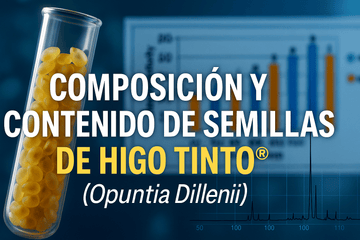
What if the seeds of the TINTO® FIG were not a waste product, but a nutraceutical gem full of antioxidants and good fats?
A study published in the Pharmacognosy Journal demonstrated that the seed oil of Opuntia dillenii (TINTO FIG®) contains high amounts of unsaturated fatty acids, phenolic compounds, and an antioxidant capacity comparable to ascorbic acid (vitamin C). Furthermore, it can be used as a functional ingredient in food, even as a partial substitute for butter. .
Red Fig Seeds®: A Forgotten Source of Health
Often discarded after the fruit is consumed, the seeds of Opuntia dillenii represent up to 9.5% of the fruit's weight , but contain extraordinary biological potential:
-
6.5% oil content
-
Rich in minerals such as calcium, phosphorus, and potassium
-
High concentration of essential fatty acids such as linoleic acid (omega 6) and phenolic antioxidants
Composition of the TINTO FIG® seed oil
The oil was extracted by hydrodistillation and its analysis by gas chromatography (GC-MS) revealed an exceptionally rich composition:
| Fatty acid | Guy | Percentage |
|---|---|---|
| Linoleic acid (C18:2) | Polyunsaturated (omega 6) | 72.9% |
| Palmitic acid (C16:0) | Crowded | 15.12% |
| Stearic acid (C18:0) | Crowded | 7.51% |
-
Total unsaturated fatty acids: 72.9%
-
Total saturated fatty acids: 22.63%
-
Unsaturated/saturated ratio: 3.22 — very healthy
Antioxidant activity comparable to vitamin C
The ability of the seed oil to neutralize free radicals (DPPH) was evaluated, with very positive results:
-
Antioxidant activity between 36.5% and 78.1% , depending on the concentration
-
Statistically similar results to those of ascorbic acid up to 100 µg/mL
-
This makes it an excellent protective agent against cellular aging, inflammation, and lipid deterioration in food.
Application in food: butter substitute in baking
The researchers made cakes by substituting butter with FIG TINTO® seed oil in different percentages (5%, 10%, 15%). The results were surprising:
-
High sensory acceptance in taste, texture and color, especially in the 5% and 10% versions
-
The oil slowed oxidation during storage , lowering peroxide levels.
-
No significant differences were detected with the synthetic antioxidant BHT in fat protection
This confirms its use as a natural alternative to traditional fats , even in baked goods.
Why is linoleic acid important?
Linoleic acid (omega 6):
-
It is an essential fatty acid that the body cannot synthesize.
-
It plays a role in regulating cholesterol and cardiovascular health
-
It is involved in the formation of arachidonic acid , present in neuronal and hepatic membranes.
-
It has protective effects against colon cancer and other inflammatory processes.
Comparison with other vegetable oils
| Oil | Linoleic acid (%) |
|---|---|
| TINTO FIG® | 72.9% |
| Soybean oil | 49.7% |
| Sunflower | 49.7% |
| Sesame | 44.5% |
| Corn | 47.7% |
| Olive oil | 3.5–21% |
The seed oil of FIGOTINTO® far surpasses most conventional oils in omega-6 concentration .
Future applications
The seed oil of FIGO TINTO® is emerging as:
-
Functional ingredient for healthy foods and antioxidants
-
Alternative to BHT as a natural preservative
-
Raw material for premium cosmetic oils
-
A sustainable option for biofuel production
Conclusion
The seed oil of the RED FIG® (Opuntia dillenii) is a rich source of healthy fats, antioxidants, and minerals , with applications in functional foods, cosmetics, and nutraceuticals. Its protective effects, balanced lipid profile, and sensory performance in food position it as one of the hidden gems of the cactus .
At Tuno Canarias, we believe that nothing is wasted when science illuminates what was previously unknown. The seeds of the TINTO FIG® represent a new frontier in health and sustainability.
Study reference
Alsaad AJ et al. (2019)
Extraction and Identification of Cactus Opuntia dillenii Seed Oil and its Added Value for Human Health Benefits .
Pharmacognosy Journal , Vol. 11(3), 579–587.