

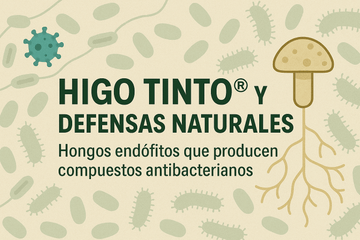
Did you know that the TINTO FIG® contains microorganisms that produce powerful natural antibiotics, even against resistant bacteria like MRSA?
A study conducted in Sri Lanka has discovered that endophytic fungi living within the internal tissues of Opuntia dillenii (TINTO FIG®) produce bioactive compounds with strong antimicrobial activity. Among these, equisetin , isolated from the fungus Fusarium sp. , stands out as effective against Gram-positive bacteria such as Staphylococcus aureus , Bacillus subtilis , and its multidrug-resistant variant (MRSA).
What was investigated?
-
Eight endophytic fungi were isolated from the pads and flowers of HIGO TINTO® collected in Bundala National Park, in the arid region of southeastern Sri Lanka.
-
Ethanolic extracts were tested against pathogenic bacteria and Candida albicans .
-
The two most active fungi were identified as Fusarium sp. and Aspergillus niger .
-
The active compound was isolated, purified and characterized from the Fusarium fungus using chromatography and spectroscopy.
What is horsetail?
Equisetin is a tetramic acid derivative that:
-
It was first isolated from Fusarium equiseti
-
It has antimicrobial, antifungal, cytotoxic, and antiviral activity.
-
It inhibits key enzymes such as HIV integrase
-
It has a stable structure and selective activity against Gram-positive bacteria.
Antimicrobial activity results
| Microorganism | MIC (μg/mL) of equisetin |
|---|---|
| Bacillus subtilis | 8 μg/mL |
| Staphylococcus aureus | 16 μg/mL |
| MRSA (methicillin-resistant) | 16 μg/mL |
| E. coli , P. aeruginosa , Candida albicans | No activity detected |
This confirms a potent and selective effect against Gram-positive bacteria , which may be of great interest for skin, digestive, or respiratory infections.
Why is this finding important?
-
First time that equisetin has been isolated from an endophytic fungus of the TINTO® FIG.
-
These fungi live in symbiosis with the plant, possibly helping it to withstand extreme environmental conditions and protecting it from pathogens.
-
They are a potential source of new natural antibiotics , at a time when antibiotic resistance is considered a global threat.
How is this applied to natural products today?
Although horsetail has not yet been commercially exploited, this study confirms that the RED FIG® is functional not only due to its nutrients, but also because of its internal microbiological ecosystem . At Tuno Canarias, we are working to translate these findings into natural products with protective, antioxidant, and immune-boosting properties.
Formulas inspired by this natural defense mechanism include:
-
BOOST with FIG TINTO® – with ginger and turmeric, ideal for strengthening the immune response and reducing oxidative stress
-
Digestive Creamer – with prebiotic fiber and RED FIG® extract, beneficial for the gut microbiota and digestive defense
-
HIGO TINTO® Family Max – sugar-free, designed for family use, with protective pigments and bioactive compounds
-
100% Organic Tinto Fig® Powder – ideal option for custom capsules or antioxidant formulas
Conclusion
The RED FIG® is not only nutritious and antioxidant. It harbors a microbial network that supports health , capable of generating bioactive compounds such as equisetin, effective against resistant bacteria. This symbiotic capacity makes it an even more valuable ingredient in functional health and pharmaceutical development.
The smartest defense may lie in the most invisible life: the endophytes of the RED FIG®.
Reference
Ratnaweera, PB, de Silva, ED, Williams, DE, Andersen, RJ (2015)
Antimicrobial activities of endophytic fungi obtained from the arid zone invasive plant Opuntia dillenii and the isolation of equisetin from endophytic Fusarium sp.
BMC Complementary and Alternative Medicine, Vol. 15, Art. 220